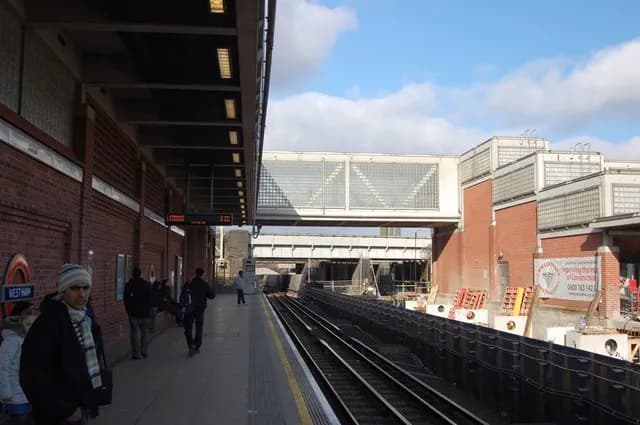
West Ham station stands as one of East London's most important transport interchanges, serving more than 16 million passenger journeys annually and connecting five separate rail systems. The station's evolution from a modest 1901 infill stop to an award-winning eight-platform hub mirrors the broader transformation of West Ham itself: from marshy riverside parish to industrial powerhouse, and now to a well-connected residential and commercial centre within the London Borough of Newham.
Historical Roots in the Marshes
The name West Ham first appears in an Anglo-Saxon charter from 958, though the division between West Ham and East Ham occurred sometime between 958 and 1037. The name derives from the Old English "hamm," meaning a dry area of land between rivers or marshland; an apt description for a settlement bounded by the rivers Lea, Thames, and Roding.
For centuries, West Ham remained a rural parish of approximately 4,500 acres within the Becontree hundred of Essex. The Metropolitan Building Act of 1844 changed everything. By prohibiting noxious industries within London's boundaries, the Act triggered a mass migration of factories to the west bank of the River Lea. By 1886, The Times observed that "factory after factory was erected on the marshy wastes of Stratford and Plaistow," transforming "the once desolate parish of West Ham" into what became known as "the factory centre of the south of England."
The Station Opens
The London, Tilbury and Southend Railway opened West Ham station on 1 February 1901 as an infill stop between Bromley-by-Bow and Plaistow. The timing coincided with rapid population growth fuelled by industrialisation. By the time of the 2011 Census, the West Ham ward alone housed 15,551 residents, with the wider area sitting just 6.1 miles east of Charing Cross.
The original station served the developing residential neighbourhoods that grew up around the factories. Historic sub-districts within West Ham include Stratford, Canning Town, Plaistow, Custom House, Silvertown, Forest Gate, and the western reaches of Upton Park. Each developed its own character around specific industries, particularly the Thames Ironworks and Shipbuilding Company, which gave West Ham United Football Club its nicknames: "the Irons" and "the Hammers."
The Jubilee Line Extension Transformation
The station's modern form took shape between 1993 and 1998, when a £10.5 million rebuild as part of the Jubilee Line Extension completely transformed the site. Designed by van Heyningen and Haward Architects, the new station earned a Royal Fine Art Commission Trust Award for its architectural quality.
Today, West Ham station operates eight platforms arranged as four island platforms, all offering step-free access. The station straddles London fare zones 2 and 3, making it an affordable gateway for commuters from Essex and East London alike.
Five Systems, One Hub
The station's current service pattern reflects its status as a genuine multi-modal interchange:
The Jubilee line offers the highest frequency, with 24 trains per hour running to Stratford and 24 to West Hampstead during peak times. Night Tube services operate on Friday and Saturday nights, running through to Sunday morning. From West Hampstead, services continue to Willesden Green, Wembley Park, and Stanmore.
c2c services provide eight trains per hour to Fenchurch Street and eight to Barking during off-peak periods. Four of the eastbound services continue to Shoeburyness via Basildon, two run to Grays via Rainham, and two terminate at Southend Central via Ockendon.
The District line maintains 12 trains per hour to Upminster and three to Barking, with 15 westbound services to Earl's Court. From there, six continue to Ealing Broadway, six to Richmond, and three to Wimbledon.
The Hammersmith and City line offers six trains per hour in each direction, connecting West Ham to Barking and Hammersmith.
The Docklands Light Railway arrived on 31 August 2011, using former North London Line infrastructure. Six trains per hour now run to Stratford International and six to Woolwich Arsenal, connecting West Ham directly to Canary Wharf, London City Airport, and the ExCeL exhibition centre.
Passenger Numbers
In 2024, London Underground recorded 5.26 million entries and exits at West Ham, making it the 112th busiest station on the network. National Rail figures for 2024–25 show 11.065 million entries and exits, with 5,599 interchanges. Combined, these figures place West Ham among the most heavily used stations in Outer London.
Remembering the 1976 Bombing
The station's history includes tragedy. On 15 March 1976, an IRA bomb exploded on a train at West Ham, killing driver Julius Stephen and injuring nine passengers. A commemorative plaque installed in 2022 on the District and Hammersmith and City line platforms marks the site of the attack, which occurred during a period of heightened paramilitary activity in London.
Looking Forward
West Ham station continues to evolve. Two new footbridges opened in 2025, crossing the railway and Manor Road to connect the station to the TwelveTrees Park development, a major housing project on the former West Ham football ground site. A new station entrance linking the Jubilee line platforms directly to TwelveTrees Park is under construction and expected to open in 2027.
These improvements build on infrastructure developed for the 2012 Olympic Games, when a temporary footbridge connected the station to the Greenway pedestrian and cycle route serving the Olympic Park. The removal of that temporary structure by the end of 2012 marked the transition from Games-time infrastructure to permanent regeneration.
Local Context
West Ham station sits within the London Borough of Newham, created on 1 April 1965 from the merger of the County Boroughs of West Ham and East Ham. With an estimated population of 374,523 in 2024, Newham ranks as the third most populous London borough. The area has the lowest proportion of White British residents of any London borough, at 14.8% according to the 2021 Census, reflecting decades of immigration and demographic change.
The station provides residents with direct access to the Queen Elizabeth Olympic Park, a 560-acre site prepared for the 2012 Summer Olympics and now home to the ArcelorMittal Orbit, Westfield Stratford City shopping centre, and ongoing residential and commercial development. Nearby Stratford, connected by frequent Jubilee line services, serves as the area's primary commercial and administrative centre.
For West Ham residents, the station represents more than a transport interchange. It is the physical manifestation of the area's reinvention: from marshy agricultural land to industrial heartland, through post-war decline and Olympic regeneration, to its current status as a well-connected East London neighbourhood with fast links to central London, Essex, and the Docklands business district.